European Fertility Week 2 - 8 November 2026
Double Duty - Fertility@Work
Infertility diagnosis or treatment and work rarely get talked about in the same breath. Yet the reality for millions of people across Europe is that they are navigating hormone injections, last-minute clinical appointments, and the emotional weight of hope and uncertainty, all while trying to show up, perform, and not let anything show at work.
1in6 people of reproductive age face fertility challenges. This amounts to 25 million individuals in the European Union alone. Almost all of them work somewhere. This is why EFW2026 is so important. It creates a dedicated opportunity to bring fertility and reproductive health into workplace conversations, shifting the focus from individual resilience to systemic support.
By encouraging employers, policymakers, healthcare providers, and employees to work together, EFW2026 highlights that fertility challenges are not simply private matters but workplace issues that affect wellbeing, productivity, retention, and equality. Tackling these challenges systemically - through inclusive policies, flexible working arrangements, manager education, and cultures where people feel safe to ask for support - benefits everyone. It enables individuals to access the care they need without sacrificing their careers, helps organisations retain talented employees and foster healthier workplaces, and contributes to a more equitable society where people are not forced to choose between building a family and building a career.
Taking the conversation to the European Parliament
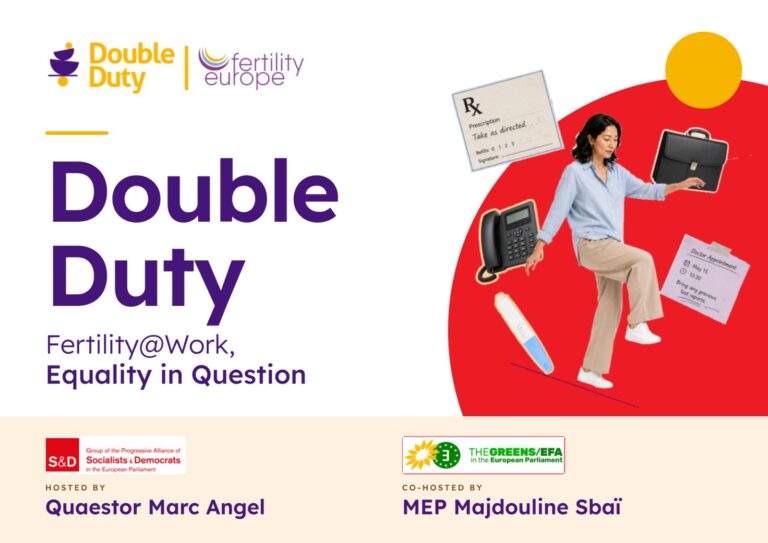
A key moment of European Fertility Week was the event "Double Duty: Fertility@Work, Equality in Question", held on 4 November 2026 at the European Parliament in Brussels.
Hosted by Quaestor Marc Angel and co-hosted by MEP Majdouline Sbaï, the event brought together policymakers, employers' and employees' representatives, health experts, European organisations and people with lived experience.
The discussion explored how fertility challenges intersect with employment, gender equality and economic security, and why stronger recognition and support are needed at both European and national levels.
READ MORE ABOUT THE EVENT AT THE EUROPEAN PARLIAMENT
The Double Duty Report: Evidence for change
At the heart of this year's campaign was the launch of Fertility Europe's Double Duty: Career Impact, Workplace Policies and the Support People Need report.
Based on responses from 2,717 people across 33 countries and territories, the report examines how infertility and fertility treatment influence career decisions, working conditions, mental well-being and relationships at work. It also explores existing workplace provisions and what employees say they need.
The findings highlight a significant gap between the realities of fertility treatment and the support available in working environments, making a strong case for change.
READ THE FULL REPORT
From findings to action: Double Duty Takeaways
Awareness is an important first step, but meaningful change requires practical action.
Drawing on the report's findings, Fertility Europe developed a set of Double Duty Takeaways for five key groups: policymakers, employers, HR professionals, managers and employees.
These resources offer practical considerations, recommendations and ideas to help make workplaces more fertility-aware and ensure that people do not have to compromise their health, careers or privacy when navigating fertility challenges.
EXPLORE THE DOUBLE DUTY TAKEAWAYS
Recommendations: Turning awareness into meaningful change
The campaign also puts forward a set of recommendations aimed at creating lasting change in how fertility is recognised and accommodated in working life. These call for action at both European and national levels, including stronger policy recognition of fertility-related needs, dedicated time off for diagnosis and treatment, greater workplace flexibility, clearer support policies and better-informed managers. The recommendations highlight that progress requires more than individual goodwill: it calls for a shared commitment from policymakers, employers and other stakeholders to make fertility-aware workplaces part of everyday working life.
EXPLORE THE DOUBLE DUTY RECOMMENDATIONS